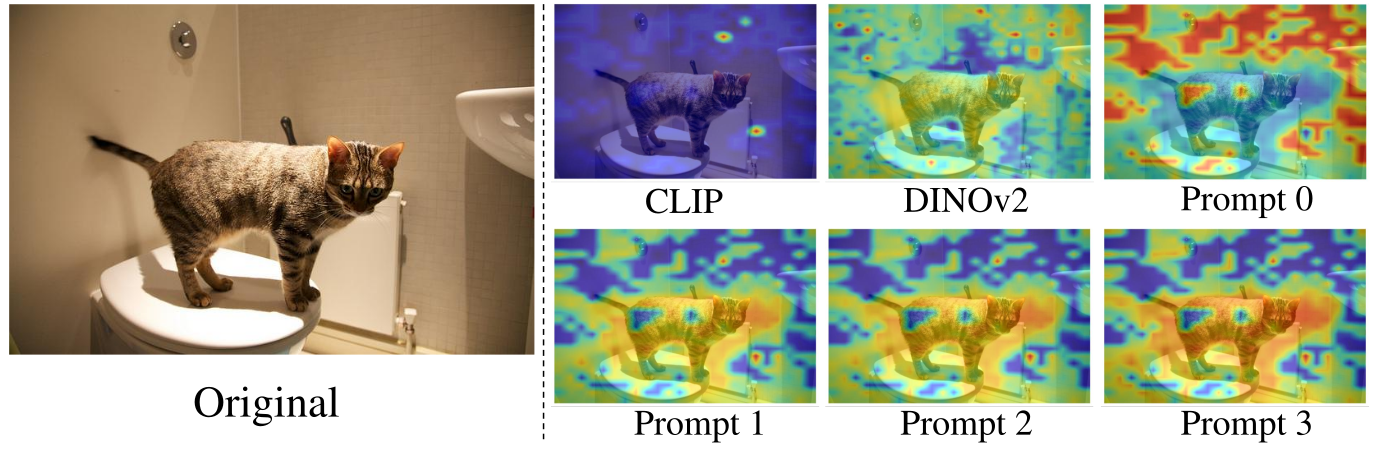
Prompts absorb complementary VFM knowledge through gated cross-attention, then remain as lightweight visual anchors at inference.
SSVAL
Mitigating Visual Degradation in MLLMs via Spatial-Spectral Visual Anchor Learning
1 China University of Petroleum (East China)
2 Shanghai Jiao Tong University
3 Wuhan University
4 Great Wall Motor
5 Nanyang Technological University
6 The University of Hong Kong
* Corresponding authors
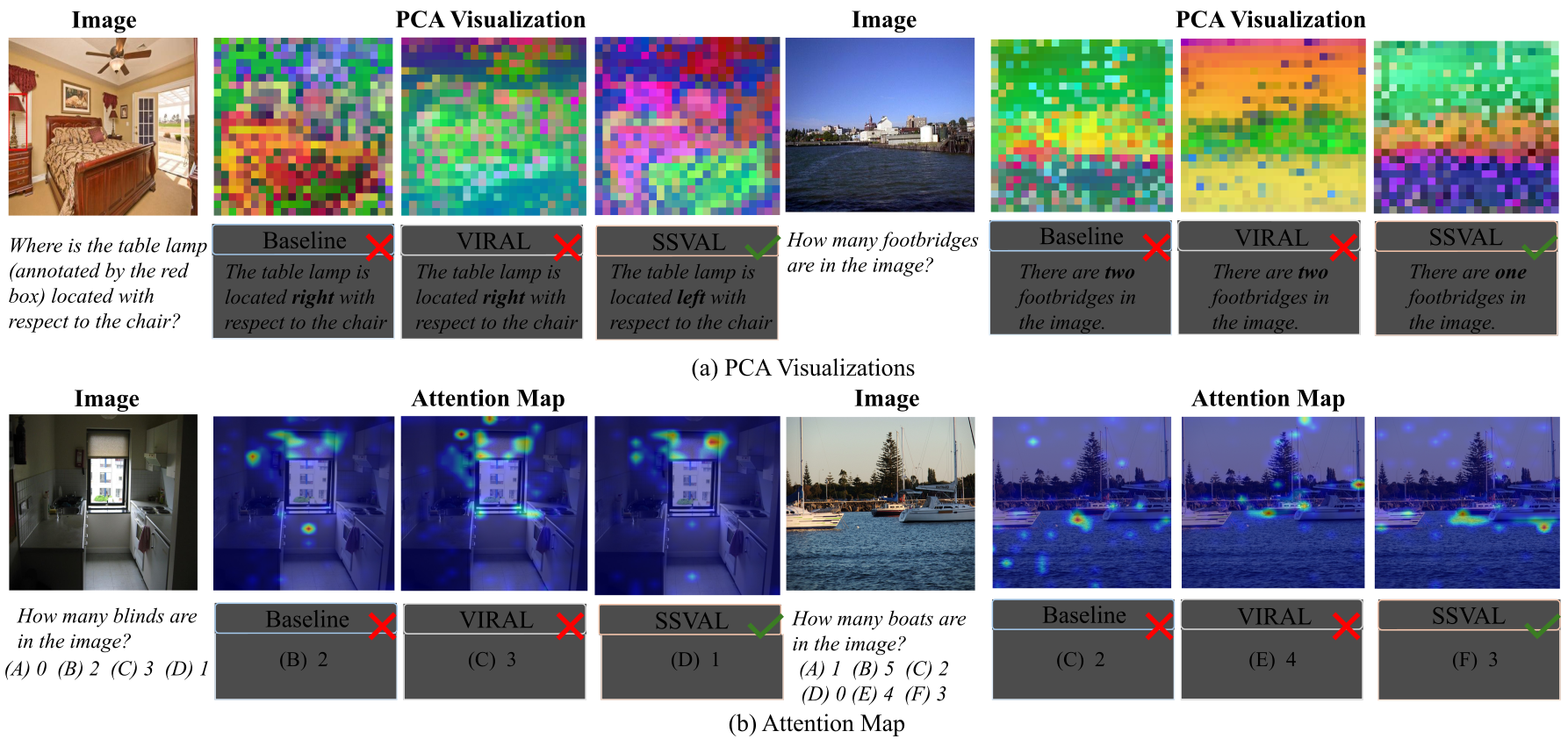
How can an MLLM retain rich visual evidence as representations propagate through deeper language layers?
SSVAL learns visual anchors that stay with the model during inference. Prompts absorb complementary knowledge from external vision foundation models during training, while spatial and frequency-domain objectives provide targeted supervision to intermediate layers. The result is stronger visual perception without carrying the external VFM into deployment.
Abstract
Despite the progress of multimodal large language models (MLLMs), they continue to exhibit deficiencies in visual perception. Following visual instruction tuning, internal MLLM representations rapidly deviate from their original semantic states during inference, causing severe information degradation. While existing methods attempt to leverage external vision foundation models (VFMs) to align internal representations, we find that direct alignment with VFMs enhances visual semantics but fails to mitigate representation deviation. To address this, we propose Spatial-Spectral Visual Anchor Learning (SSVAL). The core of SSVAL is Visual Anchor Prompt Injection (VAPI), which introduces prompts that absorb rich knowledge from external VFMs during training, enabling them to serve as stable visual anchors that mitigate representation deviation during inference. Additionally, we incorporate auxiliary spatial and frequency-domain representation alignment losses to provide complementary vision-specific supervision at intermediate LLM layers. Extensive experiments demonstrate that SSVAL significantly outperforms existing methods.
Model Architecture
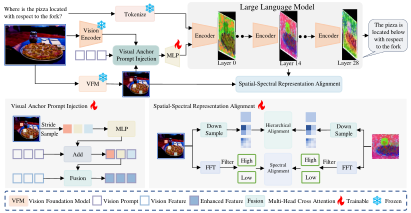
Anchors at inference. Complementary supervision at training.
Multi-scale spatial alignment preserves both fine-grained details and global structure across intermediate layers.
Frequency-domain alignment reinforces global semantics while retaining complementary high-frequency cues.
Experiment Results
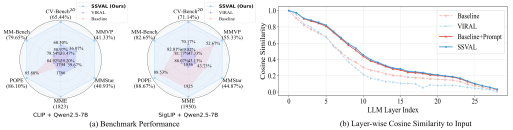
SSVAL achieves consistent gains with negligible inference cost. The training-only alignment objectives add no deployment overhead, while the retained visual anchors require only a marginal increase in parameters and computation.
+6.47%CV-Bench 2D
+7.86%MMVP
+1.55%Inference parameters
+0.04%Inference FLOPs
| Method | Vision Encoder | LLM | CV-Bench2D | MMVP | MMStar | MME | POPE | MM-Bench |
|---|---|---|---|---|---|---|---|---|
| Baseline | CLIP | Qwen2.5-3B | 51.53% | 28.00% | 36.40% | 1579.16 | 86.97% | 74.59% |
| VIRAL | 52.85% +1.32 | 32.00% +4.00 | 37.07% +0.67 | 1531.05 -48.11 | 84.97% -2.00 | 75.38% +0.79 | ||
| SSVAL | 54.80% +3.27 | 33.33% +5.33 | 38.93% +2.53 | 1613.94 +34.78 | 86.60% -0.37 | 77.41% +2.82 | ||
| Baseline | CLIP | Qwen2.5-7B | 58.97% | 33.47% | 39.20% | 1743.56 | 85.88% | 78.54% |
| VIRAL | 60.50% +1.53 | 36.07% +2.60 | 39.67% +0.47 | 1765.65 +22.09 | 84.92% -0.96 | 78.54% +0.00 | ||
| SSVAL | 65.44% +6.47 | 41.33% +7.86 | 40.93% +1.73 | 1822.72 +79.16 | 86.10% +0.22 | 79.65% +1.11 | ||
| Baseline | SigLIP2 | Qwen2.5-7B | 69.82% | 52.67% | 43.73% | 1924.64 | 88.53% | 82.01% |
| VIRAL | 70.17% +0.35 | 47.33% -5.34 | 43.13% -0.60 | 1856.21 -68.43 | 88.07% -0.46 | 81.77% -0.24 | ||
| SSVAL | 71.14% +1.32 | 55.33% +2.66 | 44.87% +1.14 | 1950.21 +25.57 | 88.67% +0.14 | 82.65% +0.64 |